
Finding Alameda County Residents
A useful Alameda County residents directory search begins by separating the question from the record. An address points to the Parcel Viewer and the assessment roll. An owner name can then lead to the Clerk-Recorder's grantor-grantee index. A court question belongs in the Alameda Superior Court portal. A family-history question may be answered by Oakland directories, voter registers, obituaries, or census pages. None of those sources is a complete list of current occupants.
The best first pass preserves the distinction between a parcel, a person, and a record event. The assessor can connect a site address to an APN and property facts. A deed can name parties to a transaction. A voter system can verify one person's own registration or supply approved files for a permitted purpose. A directory can show a listed householder near a publication date. Those clues can agree without proving that every person in a household lived there.
- Start with the name, address, or time period that is already known.
- Use the county property search or Parcel Viewer to identify the APN and exact situs address.
- Translate that property clue into an owner name before searching the deed index.
- Use the court, vital, voter, or state license source that matches the question.
- Move to the library shelf or a focused California Public Records Act request when the online index stops.
Alameda County Records Offices
Alameda County's public resident records are split among offices with different custodial roles. The Clerk-Recorder holds recorded real-property instruments, vital certificates, marriage licenses, fictitious business names, and other filings. The Assessor describes parcels, assessments, maps, and values. The Registrar of Voters handles an authenticated self-service profile, aggregate election data, and restricted voter-file requests. Each source answers a narrower question than the phrase “residents directory” suggests.
The linked offices are the places to verify a result. A free index is not the same as a certified copy, and a filed mailing address is not a finding that a person occupies a site. These distinctions matter in Alameda County because a recorder search is organized by indexed party names rather than by APN or street address.
Alameda County Clerk-Recorder
1106 Madison Street
Oakland, CA
(510) 272-6362
Alameda County Assessor
1221 Oak Street, Room 145
Oakland, CA
(510) 272-3787
A public-records question that is not answered online can be scoped to an existing record through the county's public-record request route. The California Public Records Act, now Government Code sections 7920.000 and following, does not make every certificate or protected file open.
A screenshot of the Alameda County Clerk-Recorder service gateway shows why the office remains a key stop in an Alameda County residents directory search. Its service menu joins official records with certificates and filing channels, so the correct request path depends on the record type.
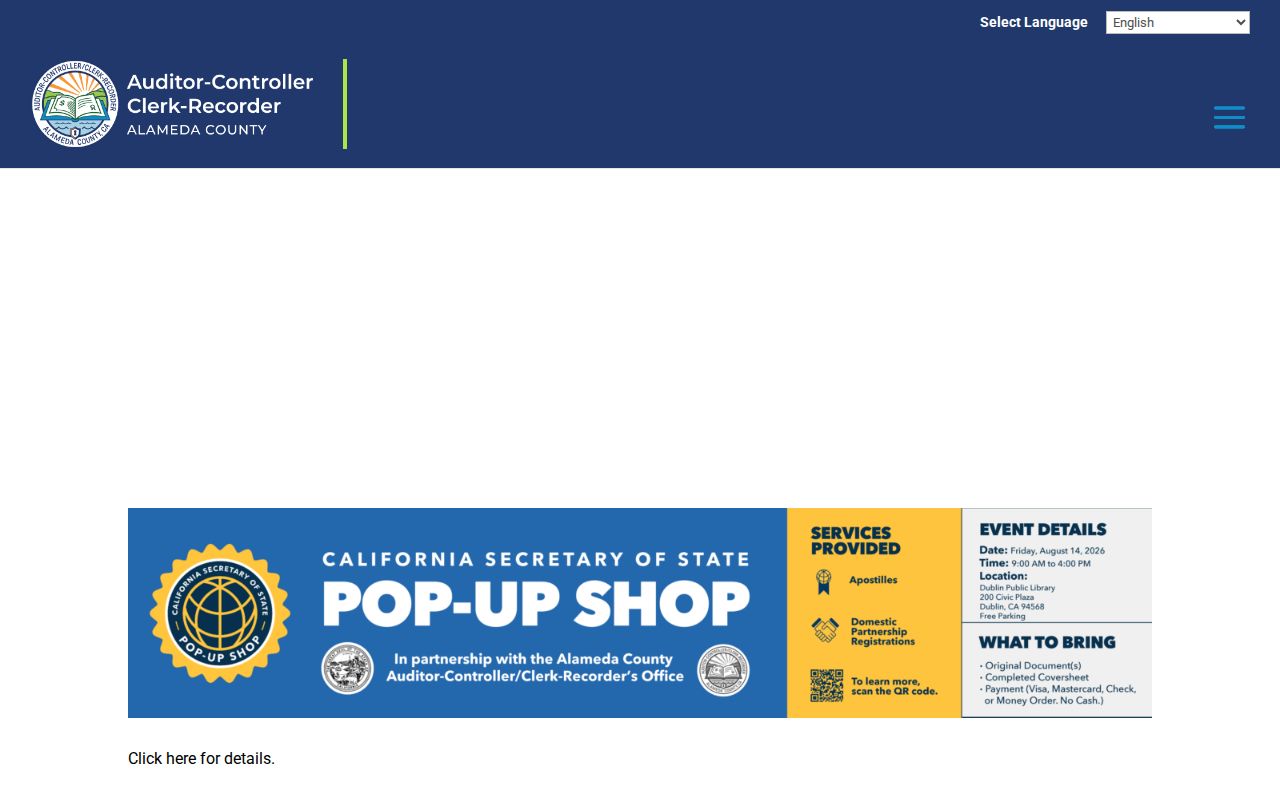
The image points to the custodian rather than a private compilation. Use the office's current instructions for access, copy orders, and protected records.
Alameda County Map to Deed Trail
The county's most reliable modern address path is map to APN to owner clue to deed index. Search the Alameda County Parcel Viewer by APN, site address, or map selection. Record the parcel number and the exact situs wording. Then use the assessment and tax portals for property context before looking for the current owner's name in Official Public Records.
This sequence prevents a common error. The recorder does not offer a general address or APN browse in its name index. A street phrase alone cannot substitute for the indexed party. The APN and legal description are the bridge when a street name changes, a mailing city differs, or a historic entry uses another form of the address.
- Parcel
- A mapped unit of land with an APN and assessment history. It is not a list of all people at the site.
- Roll
- A government record set, such as an assessment or voter roll, organized for a stated public function.
- Index
- A finding aid that points to a record or docket. It may show less than the underlying image or file.
- Criss-cross directory
- A historical address-order or telephone-order directory used to connect a house number with a listed householder.
Once the parcel clue is stable, the property tax search can check an autocomplete address or formatted parcel number. Tax status and mailing information add context, but neither source turns the Alameda County residents directory into a confirmed household list.
Why 1969 Splits Alameda County Records
Alameda County's recorded books begin in 1853, the year the county was formed from parts of Contra Costa and Santa Clara territory. The electronic name index begins in 1969. That cutoff changes the search method. For 1969 to the present, search a party name, document type, recording range, instrument number, or book and page when the portal offers it. For 1853 through 1968, plan for Oakland counter or mail research through alphabetic grantor-grantee books, microfilm, or a known reel and image.
The official-record index can show an instrument number or book-page reference, recording date, document type, indexed party, associated name, and party-role codes such as grantor or grantee. It may not show the situs address, sale price, or APN. A paid image or certified copy is a different product from the free finding aid. Recent filings may also need processing time before a copy can be ordered.
The Official Public Records gateway explains the 1969-present electronic coverage and the older search route. A view of that gateway is useful when an Alameda County residents directory trail crosses the historical boundary.
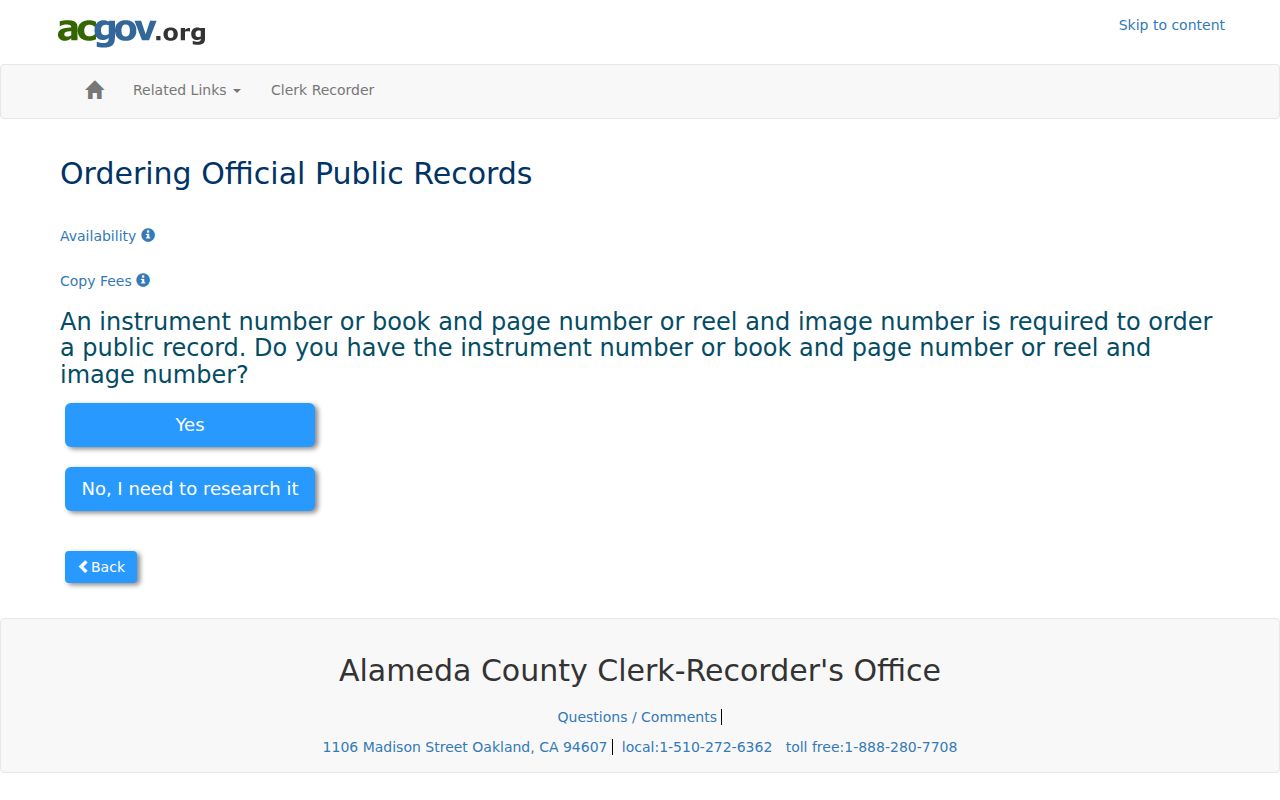
Use the screenshot as a portal cue only. The Clerk-Recorder remains the source for current search rules, copy fees, and older record instructions.
Current Alameda County Resident Directories
There is no single current Alameda County residents directory. Instead, several record sets can serve as a carefully labeled directory of people, property, or public activity. The table keeps their meanings separate.
| Source | What It Identifies | Custodian | Access |
|---|---|---|---|
| Assessment and tax search | Parcel, owner or assessee channel, mailing destination, values | Assessor and Treasurer-Tax Collector | Free address or APN search |
| Recorded instruments | Parties to deeds, liens, maps, and related filings | Clerk-Recorder | 1969-present index; older counter or mail path |
| My Voter Profile | One voter's registration, districts, ballot, and vote-by-mail status | Registrar of Voters | Self-lookup with identity fields |
| Superior Court docket | Parties, case numbers, events, and entered dispositions | Alameda Superior Court | Case-type limits; images can require payment |
| State license and business indexes | Filed affiliations, credentials, entity names, and addresses | California agencies | Free basic index, with agency limits |
A property result is strongest for an ownership question. A court result is strongest for a named party and case event. A historical directory is strongest for a listed householder near a print date. When the task is to verify one person across several records, the Alameda County resident lookup page keeps the name-first workflow in one place.
Alameda County Voter Status Is Private
My Voter Profile is a self-service verification tool, not a public street directory. The profile asks for a birth date, California driver-license or identification information, and the last four digits of a Social Security number. It can return a voter's registration data, polling place, sample ballot, vote-by-mail status, language preference, and eligible districts to that voter.
Approved voter-file requests are a separate channel. California Elections Code sections 2194 and 2188 govern permitted access and use, and the county's application asks for the requester, organization, purpose, requested fields, storage controls, and signed declarations. The standard delivery can include a Voter File, optional Participation History, and optional District File. Participation history records an election and voting method, never a ballot choice.
Use the right boundary. An absent voter result is not proof that a person lacks a connection to Alameda County. Safe at Home participants, confidential voters, inactive records, and protected fields do not create a casual public directory.
The county's registration statistics and map service supplies aggregate patterns without exposing an identified block roster. Keep voter evidence within its stated election purpose.
Alameda County Courts Are County-First
California does not provide one statewide trial-court party search that replaces county systems. Alameda Superior Court is the county source for civil, small claims, family, probate, criminal, juvenile, and traffic matters, but access changes by case type. The current Alameda Superior Court online-services page is the entry point; older references may call the public search DomainWeb while newer services use eCourt Public Portal.
A party search can return a case number, caption, party name and role, case type, filing date, courthouse, status, register-of-actions entries, hearing information, and entered disposition. Sealed cases, juvenile matters, adoption records, confidential attachments, and protected personal data are not fully public. A docket is an index of court activity, not proof that every allegation was decided.
For a result that needs context, compare the party role, filing dates, middle name or suffix, and a known address or parcel clue. Public terminals may expose docket detail or viewable images that are not available remotely. Documents can require a clerk, account, purchase, or certified-copy request. Federal matters use the Northern District of California and PACER, not the county trial-court portal.
The Alameda Superior Court online-services page is the fallback when a portal result stops at an index. A court image belongs to the court, even when it becomes a useful entry in an Alameda County residents directory search.
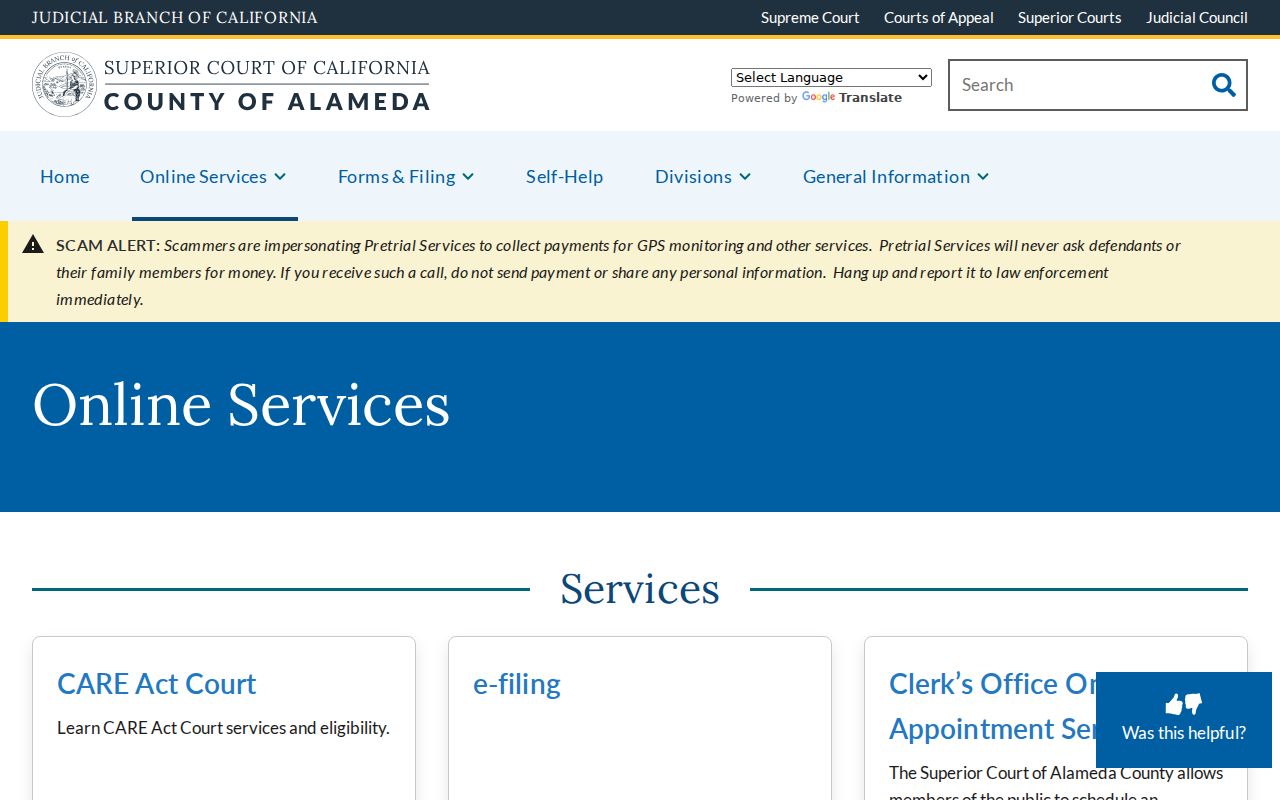
The court-service view shows the correct starting point for local case access and the need to match a search to the right division.
California Vital Copies in Alameda County
Birth, death, and marriage records have a different access structure from a property index. Alameda County Clerk-Recorder issues local certificates, while the California Department of Public Health issues statewide certified copies. California uses authorized and informational certified copies rather than a simple rule that every record opens after a fixed number of years. Health and Safety Code sections 103525 and 103526 limit authorized copies to named categories; informational copies are marked and may omit sensitive fields. Confidential marriages remain restricted under Family Code section 509.
A vital application asks for the event type, name on the record, date and place, parent or spouse names, requester details, relationship or authorized category, purpose, copies, delivery, signature, and payment. A certified copy establishes what the custodian certifies. A public index, obituary, or library certificate may supply a lead without giving the same legal proof.
For historical Alameda County work, Oakland History Center holdings include Oakland birth and death certificates from roughly 1870 or 1876 through 1904, plus local obituary files from 1951 through 1993. Those sources can connect a name to relatives, occupation, or an address trail. If a modern certificate is needed, use the California Vital Records application gateway or the county ordering page, then follow the current eligibility instructions.
Historical Alameda County Resident Directories
The historical Alameda County residents directory layer is concentrated at Oakland Public Library's Oakland History Center. Oakland city directories run from 1869 to 1943, with publication gaps that include 1919, 1920, 1929, 1931, 1932, 1936, 1942, 1944 through 1966, and 1968. Selected reverse or criss-cross volumes extend from 1936 into later decades. Digitized volumes include 1938, 1940, and 1944.
Printed entries can show a name, spouse or widow notation, occupation, residence address, and business connection. Reverse volumes switch the direction and allow an address or telephone clue to lead to a listed householder. The historical shelf also includes voter registers from 1867 through 1944, assessor block books from 1877 through 1925, selected Sanborn maps from 1882 through 1958, and newspapers and obituaries.
The full year-by-year collection treatment belongs on the Alameda County city directory page. For a short historical question, the library's holdings are often more useful than a current web roll because the old sources preserve a street, house number, and household at a specific time.
The Oakland History Center holdings page identifies the local-history room and its noncirculating materials. An image of the center's gateway is a reminder that a resident directory can be a shelf, not just a search box.
Use the center's current hours, appointment guidance, and service limits before planning an in-person visit.
Alameda County Heir and Birth-Parent Trails
A name search can serve a family-history purpose without pretending that one database will reveal a whole life. An heir search starts with an Alameda probate case, then checks the petition, register of actions, and public filings for the relationship the record actually states. A birth-parent reconnection request belongs to California's CDSS Mutual Consent Program, which uses AD 902 and releases contact only when both adult parties consent. CDSS does not search for a person on demand or solicit consent.
Classmate and reunion research can pair high-school yearbooks, city directories, the Oakland Tribune index, and the library's family-history resources. The California Genealogical Society at 1841 Berkeley Way in Berkeley offers directories, census material, vital indexes, newspapers, manuscripts, pedigrees, and Alameda obituary forms from 1968 through 1977. Restricted FamilySearch Affiliate images must be viewed onsite.
Business and professional sources can add a filed affiliation, but an entity address or license address is not proof of a home. Search the California Secretary of State bizfile index for an entity clue, then label the result accurately.
The business search screen is useful for an official filing trail, not as a substitute for a person record.
The Department of Consumer Affairs license search is the source for the next image and for current credential fields.
A license result should be read for its board, status, credential, and filed address, with the same caution about residence.
Alameda County Public-Records Fallback
When no online index answers a focused question, the California Public Records Act supplies a request path for an identifiable existing record. Agencies generally have ten calendar days to determine whether a request seeks disclosable records and may extend that determination by fourteen days for unusual circumstances. That is a determination deadline, not a promise that production will happen within ten days.
Describe the custodian, record type, address or name, date range, and known identifier. The county NextRequest service separates ordinary CPRA requests from paid copy products and protected certificate channels. A request cannot force an agency to create a new compilation, bypass authorized-copy rules, or turn a restricted voter or DMV file into an open Alameda County residents directory.
The Secretary of State CPRA guidance and the California Attorney General's plain-language guide explain the request framework. A county form also states the ten-day determination rule. Keep the question narrow enough that the custodian can identify the record.
Official record research is not the same as buying a compiled result. A commercial search tool may blend stale or mismatched facts and may charge for access. A county, court, library, or state custodian is the place to verify a claim and request a correction.
Protected Alameda County Addresses
California's Safe at Home program supplies an eligible participant with a substitute mailing address and mail forwarding. It serves survivors of domestic violence, stalking, sexual assault, human trafficking, and certain health-care or reproductive-service workers. A confidential voter or substituted address may be absent from a normal search, but that absence does not establish that the person left Alameda County.
California's privacy system also includes the CPPA DROP service under the Delete Act. DROP launched in January 2026 for verified California residents to send one deletion request to registered data brokers. Public records, first-party records, and exempt data are not erased. The separate public-record custodians remain responsible for their own correction and confidentiality rules.
The Safe at Home program explains eligibility and the substitute-address process. A screenshot from that official source can help a researcher recognize why an address trail may stop without treating the gap as evidence.
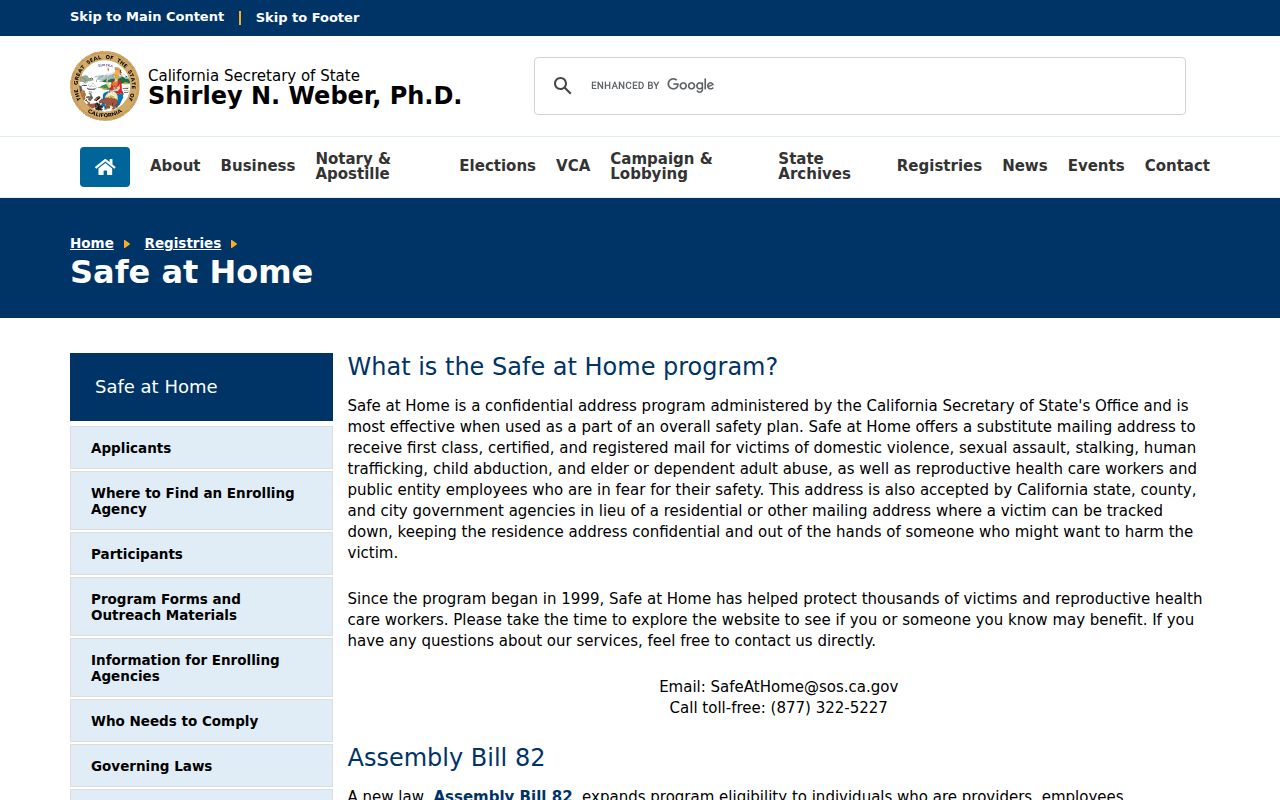
Confidentiality programs protect people, so a lawful search should respect the missing data instead of trying to work around it.
Alameda County Records in Motion
Online coverage is changing. Alameda County's AB 1466 plan estimates about twenty million historic real-estate documents and eighty million images, with only about half electronic at the planning stage. The work adds OCR and reviews restrictive covenant language while preserving older material. A January 2025 board item described microfilm processing at about 8,000 images per day.
Another change is practical rather than digital. In March 2025, postal Place Names changed for nearly 29,000 unincorporated addresses. ZIP codes, APNs, taxes, schools, services, and jurisdiction did not change, but a mailing line could shift from an older Hayward label to a community name such as Cherryland. Keep the APN and legal description when comparing an old directory with a new address.
The county's real-estate fraud notification program, launched in 2023, mails an owner when specified real-estate documents record against property and includes the first page and Fraud Unit contact. That makes the recorder index useful for public safety while still requiring a careful distinction between a recorded owner and everyone who lives at a site.
The county place-name notice and California DROP information are timely reminders to check live instructions. A strong Alameda County residents directory search records the date, custodian, identifier, access channel, and limitation for every conclusion.
The California State Controller unclaimed-property search is another dated clue for an older owner and address association.
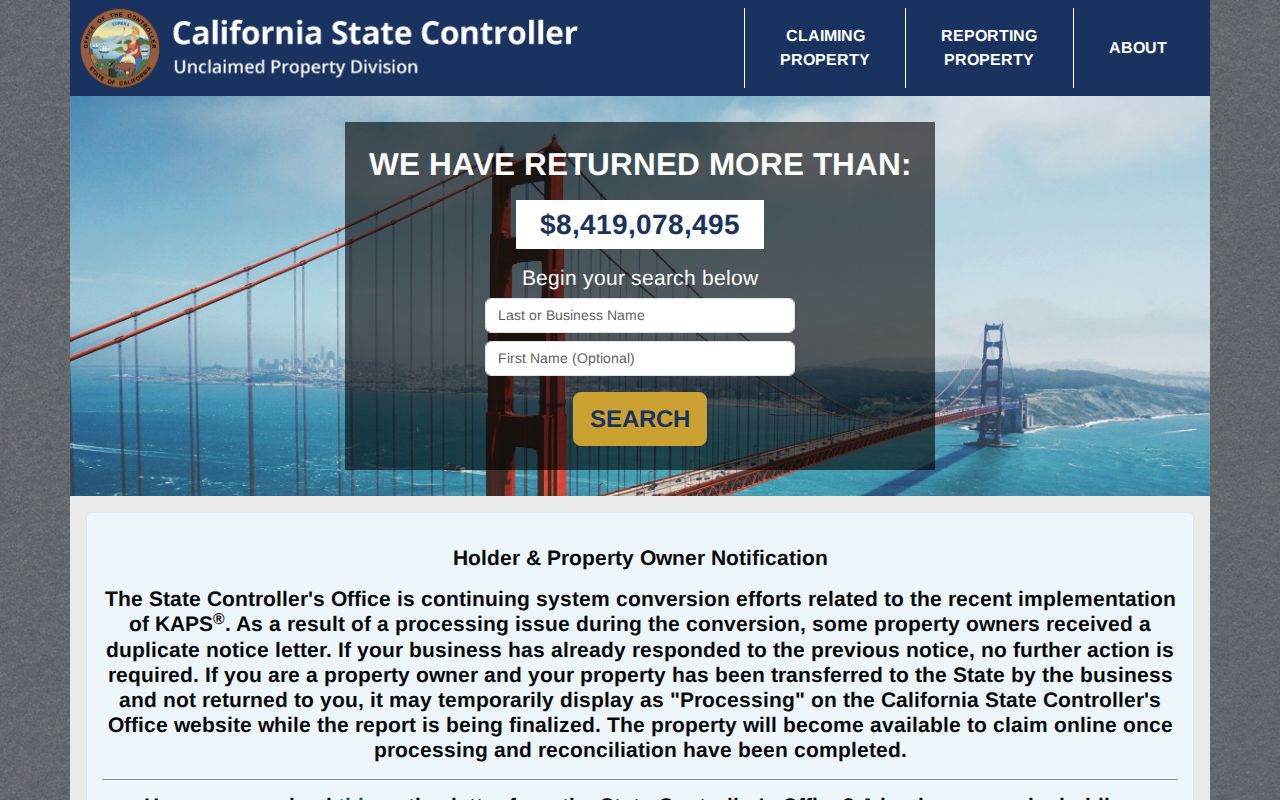
The state unclaimed-property search can preserve an old owner and address association, but it is only a clue and a claim still requires proof.
Lawful personal use. Public records support genealogy, estate work, civic research, and personal safety awareness. Do not use a record to stalk, harass, intimidate, or harm anyone, and verify important facts with the custodian.