
Alameda County Resident Lookup Coverage
A name-first Alameda County resident lookup should start with the record type that can answer the question. Property records can link a person to an owner or mailing clue. A deed identifies transaction parties. A court docket identifies a case party and event. A vital record can establish an event or relationship, subject to eligibility. A license or business filing shows an official affiliation. These are not interchangeable forms of residence proof.
| Record | What It Confirms | Where to Search | Access |
|---|---|---|---|
| Assessment or tax record | Parcel link, owner or assessee channel, mailing destination | Alameda County Assessor and tax search | Free address or APN search |
| Recorded deed or lien | Named transaction parties, date, instrument, legal description | Clerk-Recorder Official Public Records | 1969-present index; older counter or mail |
| Court docket | Party name, role, case type, filings, hearings, disposition | Alameda Superior Court | Varies by division; files may cost |
| Vital record | Birth, death, marriage, or divorce event and stated relationships | County Clerk-Recorder or CDPH | Authorized or informational copy rules |
| Voter profile | One voter's registration status, districts, and ballot details | Alameda My Voter Profile | Self-authenticated, not a public roster |
| License or business filing | Credential, entity, filed address, or official affiliation | California DCA or bizfile | Free basic index with limits |
Choose the narrowest source first. A name and known county point toward the court portal. A name and address point toward the map and assessment roll. A family question may start with the Oakland History Center. A missing result is useful only after its source limit is written down.
Alameda eCourt Name Search Fields
Alameda Superior Court is the county's trial court for civil, small claims, family, probate, criminal, juvenile, and traffic matters. The current online-services gateway may direct a researcher to eCourt Public Portal or another division-specific service. Access is not uniform. The eCourt portal covers General Civil, Small Claims, Family, Probate, Mental Health, and Adoption, while Criminal, Juvenile, and Traffic use different paths.
Use the party search to find a case number and then switch to case-number search for the register of actions, minutes, future hearings, and document indicators. A docket is a court index. It can show that a filing or hearing occurred, but it does not turn an allegation into a finding.
| Search type | Case Number or Party/Name, where the category permits. |
|---|---|
| Last or business name | Required in name mode; spelling and variant sensitive. |
| First name | Optional narrowing field for common names. |
| Filing date | Optional date range when the portal or division offers it. |
| Case type | Category such as civil, probate, family, or criminal, depending on service. |
| Case number | Direct route to parties, register entries, hearings, and available images. |
The Alameda Superior Court online-services gateway should be checked before relying on an older DomainWeb bookmark. Federal cases belong in the Northern District of California and PACER, not the county portal.
Alameda County Same-Name Cross-Checks
The same-name trap is the main accuracy risk in a resident lookup. A court hit, license result, deed party, or business filing becomes stronger when it shares a middle name, suffix, address, time period, spouse, parcel, case number, entity number, or license identifier with the known person. One matching surname is not enough.
Keep a short result log with the custodian, search date, exact spelling, record identifier, party role, and access limit. Compare a deed's legal description with the parcel map. Compare a docket party with the date and court division. Compare a directory name with a spouse, occupation, or nearby address. If the clues conflict, report the conflict rather than selecting the most convenient match.
Negative results need a reason. No hit may mean the wrong county, a spelling or OCR variant, a portal cutoff, a sealed case, a protected address, or a record that was never indexed online.
For a current address clue, begin with the Parcel Viewer and the assessment roll, then use the owner name in the recorder index. The address-to-APN method is kept separate on the Alameda County street directory page.
Verifying an Alameda County Resident
A careful Alameda County resident lookup moves from a broad clue to a record that can confirm one part of the story. The goal is not to assemble an unsupported dossier. It is to anchor the name, check independent sources, and obtain a certified or official copy only when the task requires it.
- Write the name exactly as known, including middle names, initials, suffixes, alternate spellings, and a time range.
- Anchor the name to a parcel, documented address, family relationship, business filing, or other durable clue.
- Run the Alameda court party search and preserve case number, party role, filing date, and court division.
- Check the vital index or historical source that fits the event, then compare names and dates.
- Order a certified copy from the proper custodian only after confirming eligibility and record type.
- Docket
- A court's index of a case, parties, filings, hearings, and entered events.
- Index versus image
- An index points to a record; an image or file contains more detail and may require a fee or onsite access.
- Certified copy
- A copy bearing the custodian's certification, used when an official copy rather than a research lead is needed.
- Disposition
- The recorded outcome or status of a court matter, not a summary of every claim.
What an Alameda Court Result Shows
A public result from Alameda Superior Court can provide the fields below. The result is useful because it keeps the party role and event date visible. It is not a complete case file, and confidential or sealed information may be absent.
| Case number | The court identifier used for direct lookup and copy requests. |
|---|---|
| Caption and party role | Names the case and identifies plaintiff, defendant, petitioner, respondent, decedent, or another role. |
| Case type | Civil, probate, family, criminal, small claims, or another division category. |
| Register entries | Filing, hearing, order, minute, or disposition events shown by date. |
| Document indicator | Signals a viewable or purchasable image, subject to confidentiality and access rules. |
Public courthouse terminals may expose docket detail or viewable images that are not available from home. The court does not research a case by phone or email, although written mail research and clerk channels exist. A copy request should name the case number and document before asking for certification.
A screenshot source for Alameda court locations and clerk contacts shows the local fallback when an online result is incomplete.
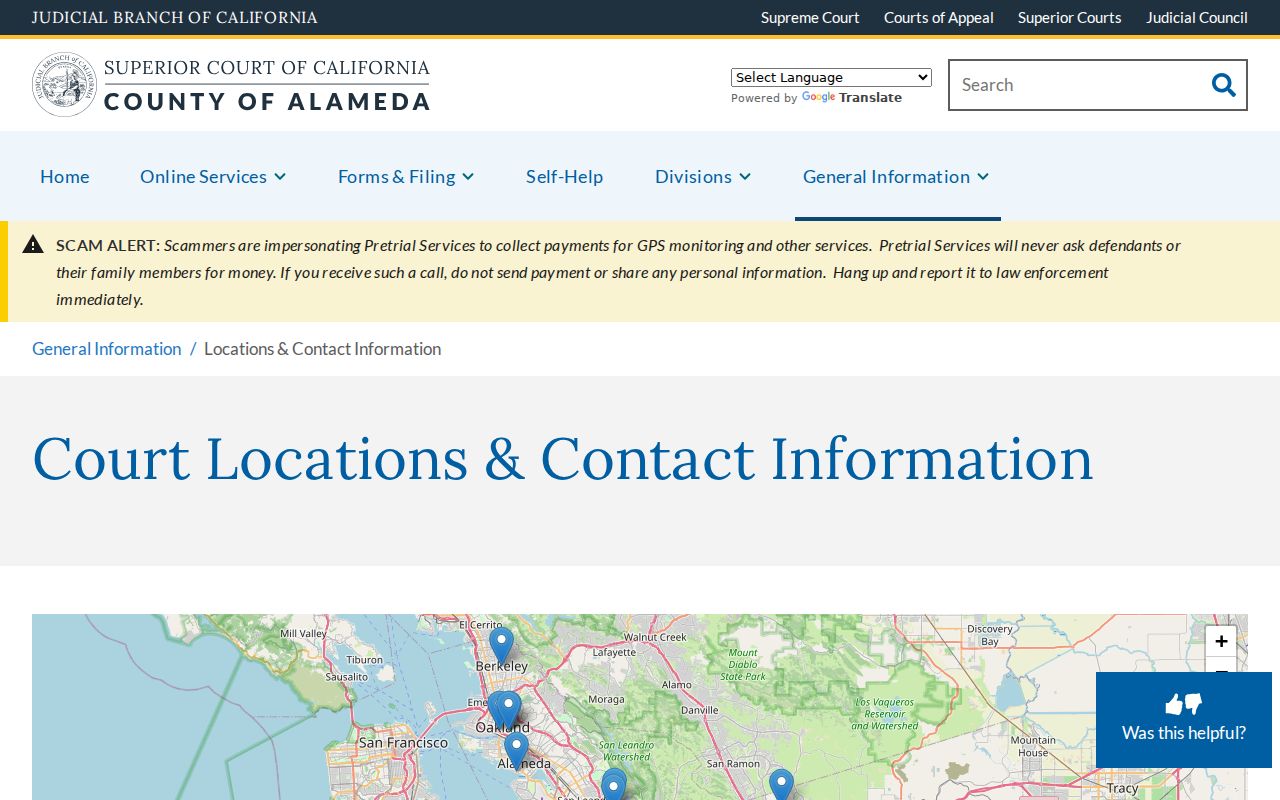
The court contact image belongs to the official access route, not to a compiled resident directory.
Vital Records and Certified Copies
Birth, death, marriage, and divorce records need a different form of verification. Alameda County and CDPH issue local or statewide certificates. Health and Safety Code sections 103525 and 103526 distinguish authorized certified copies from informational copies. An authorized copy requires the requester to fit an enumerated category and complete the required statement. An informational copy is marked as not valid to establish identity and may omit sensitive fields. Confidential marriage records remain restricted under Family Code section 509.
For 2026, the research records CDPH fees of $31 for birth, $26 for death, $19 for marriage, and $18 for a dissolution certificate of record. The state states that average certified-copy processing is four to six weeks and has no expedited service. Fees and forms can change, so use the live CDPH Vital Records page before ordering.
Historical searches can use Oakland History Center certificates from roughly 1870 or 1876 through 1904, obituary holdings from 1951 through 1993, and newspaper indexes. A library lead is valuable, but it is not the same as the certificate the county or state certifies.
The Alameda County vital-records ordering page is the local starting point for county events. The California vital-record application source is the right starting point for eligibility, forms, and current fees. A resident lookup should say whether it found an index, an informational copy, or an authorized certified copy.
Alameda Voter Status Is Self-Service
My Voter Profile is designed for a voter to check the voter's own registration and district details. It asks for date of birth, California driver-license or ID information, and the last four digits of a Social Security number. It can return polling place, sample ballot, vote-by-mail status, language preference, mailed-guide preference, and eligible districts.
Approved voter-file requests are governed by Elections Code sections 2194 and 2188. The county application requires a stated requester and purpose, requested fields, data security details, and declarations against sale, redistribution, or unauthorized use. Active registrations are automatic in the standard file; inactive records must be requested. Confidential voters and preregistered minors are omitted.
A person missing from My Voter Profile is not a negative finding for an Alameda County resident lookup. The portal is authenticated, the file is purpose-restricted, and Safe at Home can provide confidential registration. California's state registration-status gateway links voters to the county self-service route.
The official My Voter Profile service is the source for self-lookup. A screenshot of the live tool helps identify the correct portal.
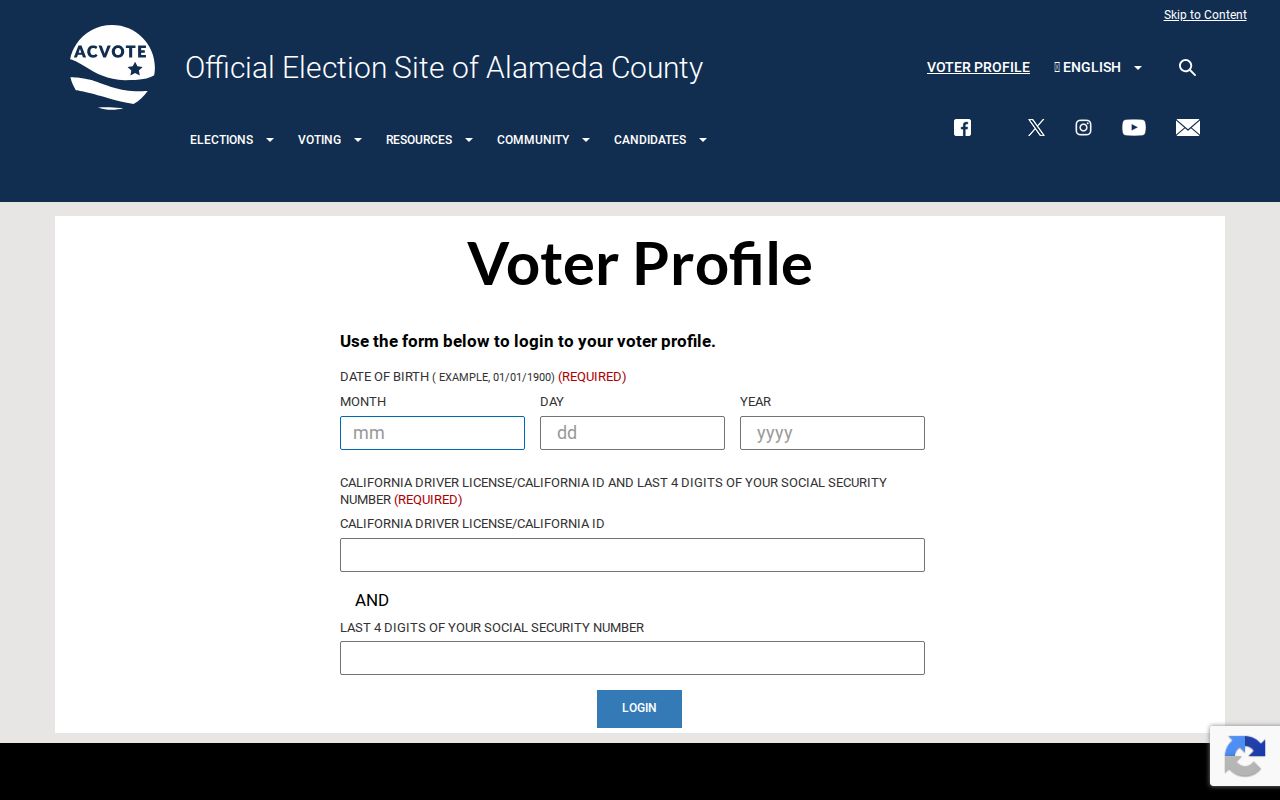
Use the profile for the authorized voter question it is built to answer, not as a public name-and-street browser.
Heirs and Birth Parents in Alameda County
An heir search starts with probate. Search the Alameda court name index, identify the case number and decedent, then read the petition and public register entries for relationships stated in the file. Confidential attachments may be withheld. A surname match alone cannot establish an heir relationship.
For birth-parent reconnection, California's CDSS Mutual Consent Program uses AD 902. Contact information is released only if the adult adoptee and birth parent both consent. CDSS does not search for people on a requester's behalf or solicit consent. The Post Permanency Services Unit handles the program through its Sacramento address.
For a classmate or family friend, Oakland yearbooks, city directories, newspaper indexes, and California Genealogical Society resources can supply a lead. The record should be framed as a reconnection or family-history path, not as proof of a current address.
Official Alameda License and Jail Sources
Some questions call for a state or county lookup outside the usual resident records. The Alameda County Sheriff Inmate Locator accepts a first, middle, or last name, PFN, sex, and date of birth, with recent-booking and phonetic controls. Pending release can take hours, and an absent result may require the arresting jurisdiction. A jail booking is not a resident lookup or a residence record.
California's Megan's Law site supports name, address-radius, ZIP, city, and county modes, with statutory exclusions and use restrictions. The Department of Consumer Affairs search can use board, license type, number, business, first name, last name, and registry number. The Secretary of State bizfile index shows entity and filing details. Each source documents a defined public function.
The Alameda County Sheriff locator is the manifest source for the local custody form. The state CDCR incarcerated-person locator is a separate name or CDCR-number search and does not establish a county residence.
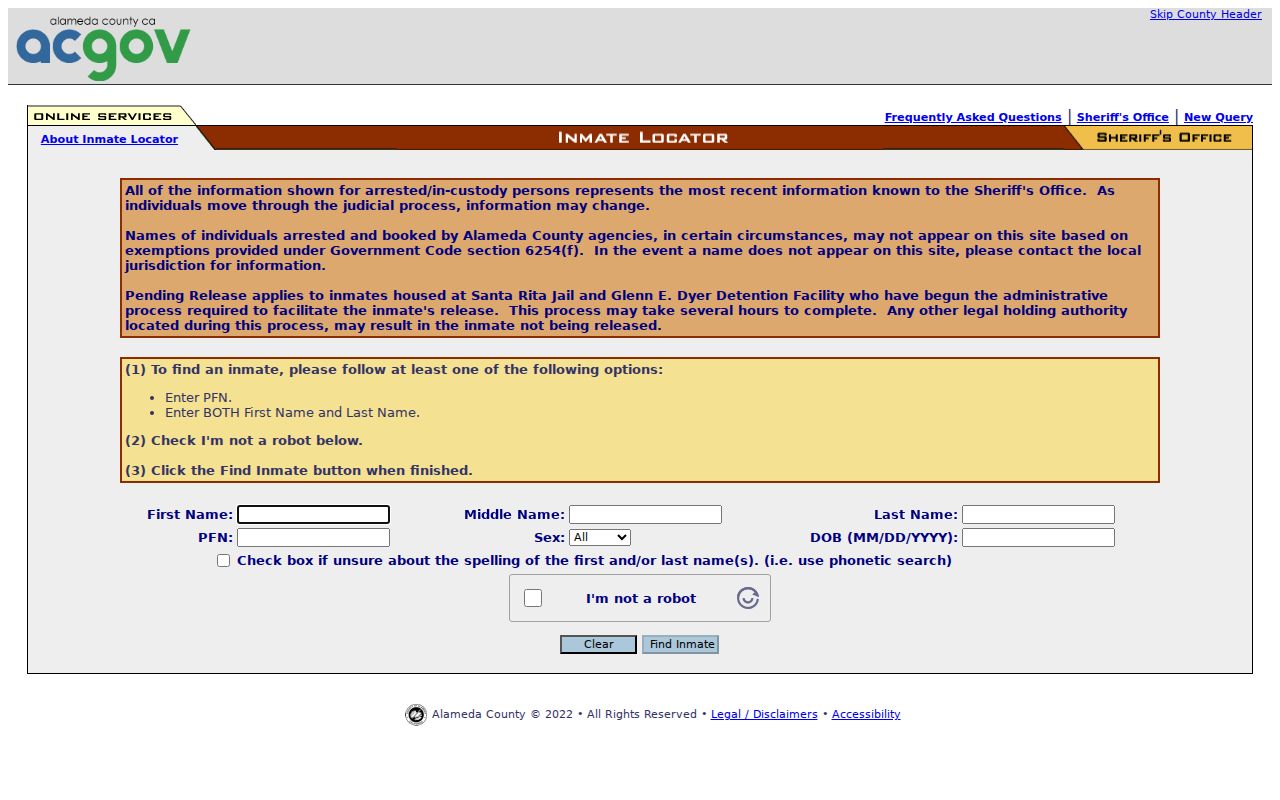
Read the result as custody information with its update limits, not as a statement about where a person lives.
The California Megan's Law registry carries its own statutory warnings. Use it only for the lawful purpose stated by the custodian.
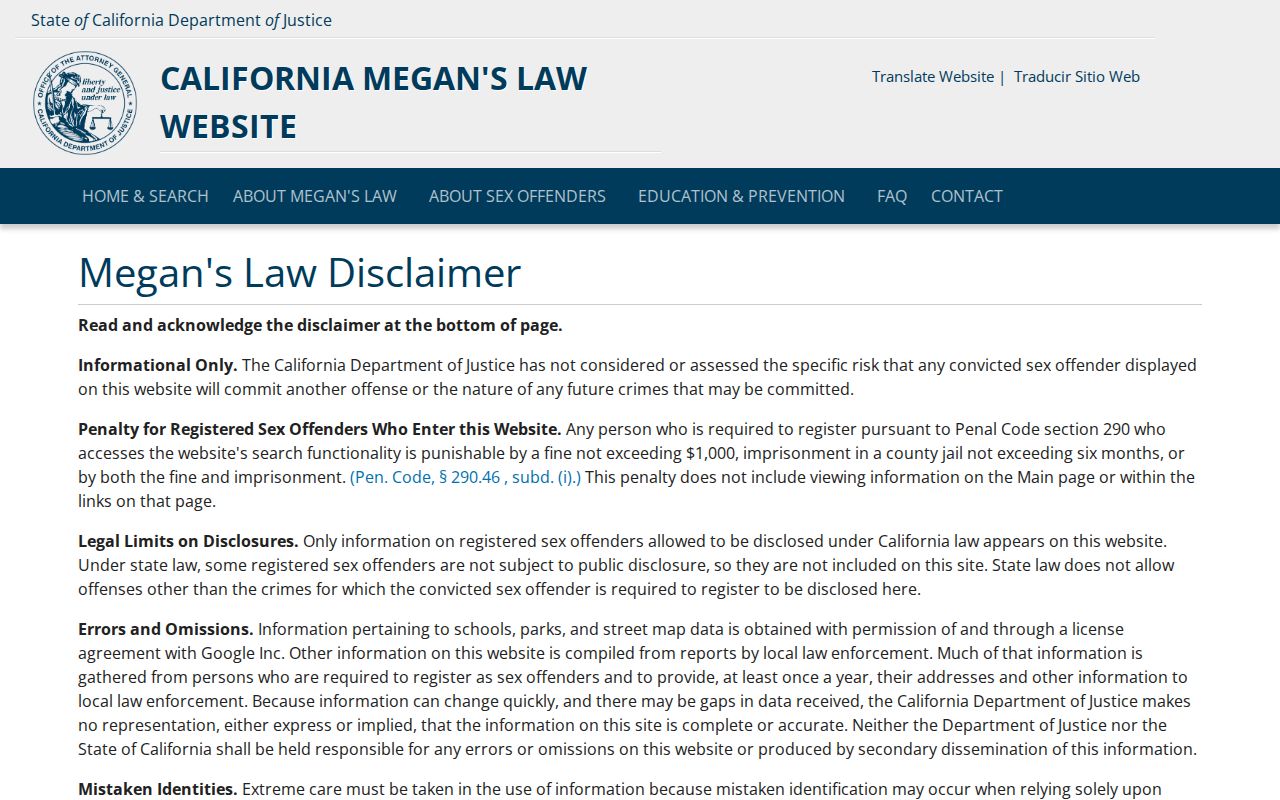
The registry image reinforces the difference between a public disclosure system and a general resident list.
Correct the Alameda Record Custodian
A compiled search result cannot amend a court docket, voter record, vital certificate, property record, license filing, or business entity. Send a correction to the custodian that created the record. Court questions go to the clerk. Election questions go to the Registrar. Vital amendments follow the county or CDPH process. A license issue belongs with its board, and a business filing correction belongs with the Secretary of State or county FBN office.
California's CPRA can request an identifiable existing record, but it does not force a new compilation or override confidentiality. A precise request names the person, date, record class, and known identifier. Keep the correction trail with the date and response.
Lawful personal use. An Alameda County resident lookup is for genealogy, estate research, civic inquiry, or a personal reconnection. Do not use it to stalk, harass, intimidate, or harm anyone. Verify important claims with the official custodian.