
Sources for Alameda County Previous Residents
A house-history search needs sources that cover different eras and roles. Deeds identify title parties. Directories identify listed householders near a print date. Census pages add relationships and ages. Permits date construction or alteration. Sanborn maps show structures and uses. Obituaries and probate files can connect a former owner or householder to relatives. The table is an era map for previous residents, not a promise that every year has a surviving name.
| Source | Years It Covers | Where Held | What It Adds |
|---|---|---|---|
| Recorded deeds and instruments | 1853-present; web index 1969-present | Alameda County Clerk-Recorder | Grantor, grantee, date, document type, legal description |
| Oakland city directories | 1869-1943, with stated gaps | Oakland History Center and digital scans | Listed name, address, spouse, occupation, business clue |
| Reverse directories | 1936-2020, selected runs | History Center and library rooms | Address-to-listed-occupant trail and nearby numbers |
| Federal census | Through 1950 under the 72-year rule | NARA and library databases | Household relationships, ages, birthplace, occupation, tenure |
| Oakland permits | Late 1905 onward; older ledgers and microfiche | Oakland Planning and Building | Applicant, contractor, project, date, status, valuation |
| Block books and Sanborn maps | 1877-1925; selected 1882-1958 | Oakland History Center | Parcel, structure, materials, use, block context |
| Donogh property cards | 1940s-1970s, bulk 1960s | Oakland History Center | Address, asking price, listing date, property description |
| Obituaries and probate | Local holdings vary; obituaries 1951-1993 | Library and Alameda Superior Court | Relatives, address clues, death or estate endpoint |
A missing row does not prove that no one lived at the address. It may mark a publication gap, a closed file, a spelling change, or a record that was never indexed online. Build the trail from the strongest available source for each date.
Walk the Alameda County Deed Chain
The deed chain is the backbone of previous-resident research, but it begins with a map. Search the Parcel Viewer by site address, APN, or map selection. Save the current APN and exact situs wording. Use assessment and tax records for a current owner or assessee clue, then search that name in the Clerk-Recorder's grantor-grantee index.
- Resolve the current parcel and write down APN, site address, owner clue, and legal description when displayed.
- Search the owner name in Official Public Records for a likely acquisition deed and record instrument number, date, grantor, grantee, and document type.
- Read the legal description and search the seller or grantor as an earlier grantee.
- Repeat backward, changing name variants and document filters as the chain crosses different eras.
- At each date, compare the title party with a directory, census, obituary, or permit before calling that person a previous resident.
- Grantor
- The party shown as transferring an interest in the recorded instrument.
- Grantee
- The party shown as receiving an interest in the recorded instrument.
- Chain of title
- The linked sequence of recorded transfers used to trace an ownership history.
- Legal description
- The land description in the instrument, which can preserve continuity when a street address changes.
Alameda's recorder is name-indexed, not address-indexed. Electronic coverage begins in 1969. Records from 1853 through 1968 require counter or mail research once a book, page, reel, or image is known. The current Official Public Records gateway explains those paths.
Cross the 1969 Alameda Recorder Line
The electronic cutoff is a practical dividing line in a previous residents search. For 1969 forward, a party name, instrument number, date range, document type, or book-page clue can lead through the electronic index. For earlier years, alphabetic grantor-grantee books and microfilm need an in-person or mail route through the Oakland office.
Do not treat a failed web search as a failed deed chain. The old record may use a different spelling, a prior owner, an earlier street form, or a book and page reference. The recorder's index may not display the situs address, sale price, or APN. A free index entry and a certified copy are separate products.
The county public-records request route can help with an identifiable existing record, but it cannot make a deed address-searchable or waive established copy and confidentiality rules. The Secretary of State's California Public Records Act guidance explains the statewide request framework. A screenshot of the county public-records request service shows the fallback route.
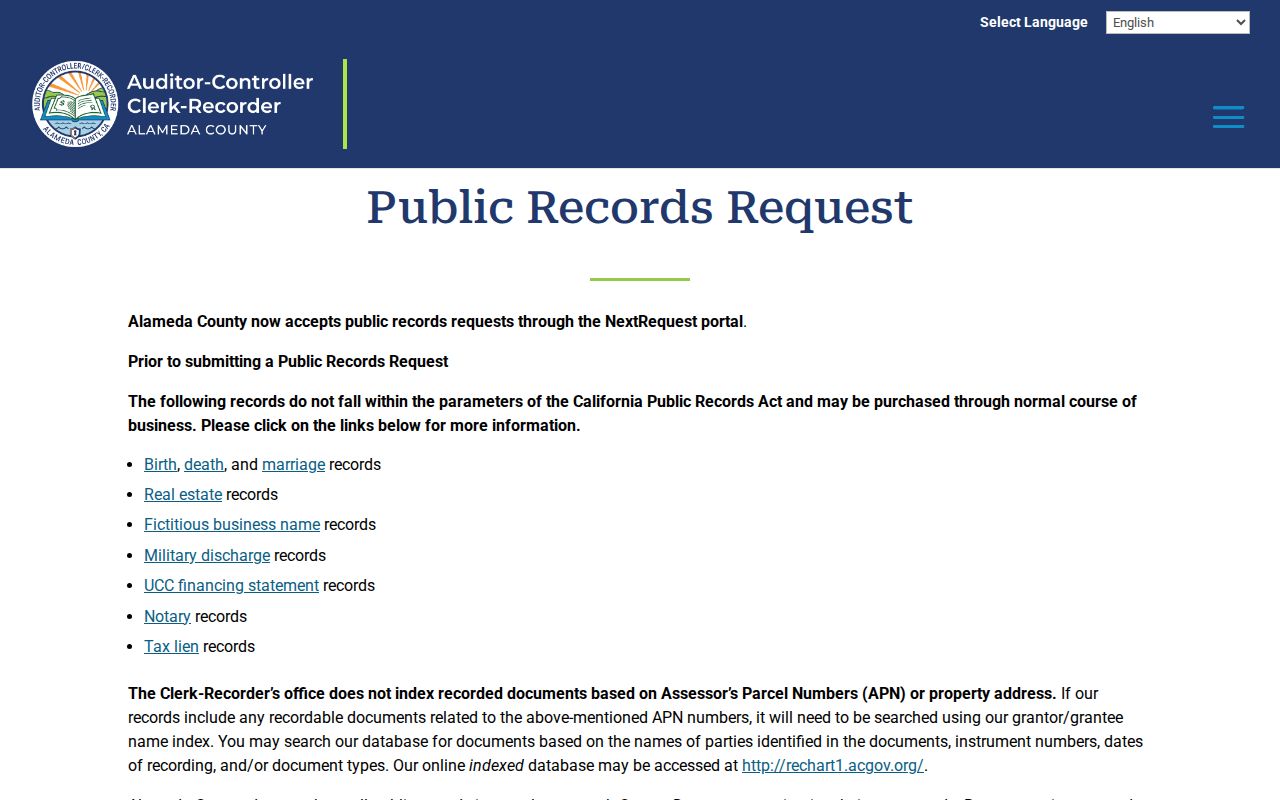
Use the live request instructions for the correct custodian, record class, and submission method.
Donogh Cards Preserve Alameda Address Clues
The Oakland History Center's Donogh collection contains roughly 5,000 East Bay real-estate listing cards from the 1940s through the 1970s, with a bulk in the 1960s. The cards are arranged by address. Each card includes the address, asking price, and listing date. An envelope may add a former owner, building age, property description, or photograph.
This is a striking local story because a small card can fill the gap between a deed and a directory. For previous residents, it can show how a property was described at a point in time, while a deed supplies the legal transfer and a directory supplies a listed person. The card is still a research source, not a household census. Preserve the card's address wording and compare it with the APN or legal description.
Numbered streets in the Donogh cards are filed as spelled-out words. Search both the numeric and written form when an address seems to vanish. The Oakland Library's house-history guide describes the local workflow and the street-name guide that helps connect older forms.
Local shortcut. When a modern parcel portal cannot explain an old address, pair the Donogh card with a reverse directory and a Sanborn map before searching the next deed.
Oakland Permits Date an Old Property
Oakland permit records begin in late 1905, with annexed-area exceptions. Early chronological ledgers and roughly 1910s through 1990 microfiche sit beside later online records. The search categories include microfiche, planning permits, building permits and private property enforcement, codes, complaints, and public-record requests.
An address search can return a record number or permit number, status date range, owner or applicant, contractor, project description, property type, location, and valuation. Those facts date work on a structure. They do not identify everyone who occupied the property. A permit can therefore support a house history while remaining separate from the previous-residents question.
For an incorporated city outside Oakland, use that city's planning or building office. County Community Development and Public Works cover unincorporated Ashland, Castro Valley, Cherryland, Fairview, San Lorenzo, Sunol, and rural areas. A permit can support a house history while remaining separate from a question about previous residents. Recorder documents remain county records in every case.
Criss-Cross Directories by House Number
Reverse directories are especially useful when the property is known but a surname is not. Oakland holdings include 1936, 1953, 1961, 1964 through 1974, and 1995, with digitized 1938, 1940, and 1944 volumes. Haines runs extend selected Oakland and Southern Alameda County coverage through 2020 and 2019.
Read the street section from the exact number, then check adjacent numbers for block context. Copy the listed name and any phone or business note. Move to the alphabetic city directory to find spouse, occupation, and another address. If the volume is missing, test a phone book, census year, obituary, or permit. Previous residents should be tied to a date and a source, not inferred from a single line.
The historical collection details and year runs are organized on the Alameda County city directory page, which owns the directory shelf rather than the modern deed chain.
Pair Alameda Addresses with Census Pages
Federal census records are available through 1950 under the National Archives' 72-year rule. Census pages add household relationships, ages, birthplaces, occupation, and tenure at the census date. A city directory can fill the years between censuses, while a deed can establish an ownership transfer. The three sources answer different questions.
- Choose the directory year nearest the census date and copy the address exactly.
- Search the same street and number in the census, allowing for enumerator spelling and district changes.
- Compare names, ages, relationships, birthplace, occupation, and tenure without assuming that a directory householder equals every household member.
- Use the next directory or census to see whether the household moved, changed, or disappeared.
- Close a death or estate trail with an obituary, cemetery record, probate case, or certificate where available.
The National Archives census guidance explains the release rule and access context. For a county record that is not posted online, the Alameda County public-record request form records the ten-day determination rule.
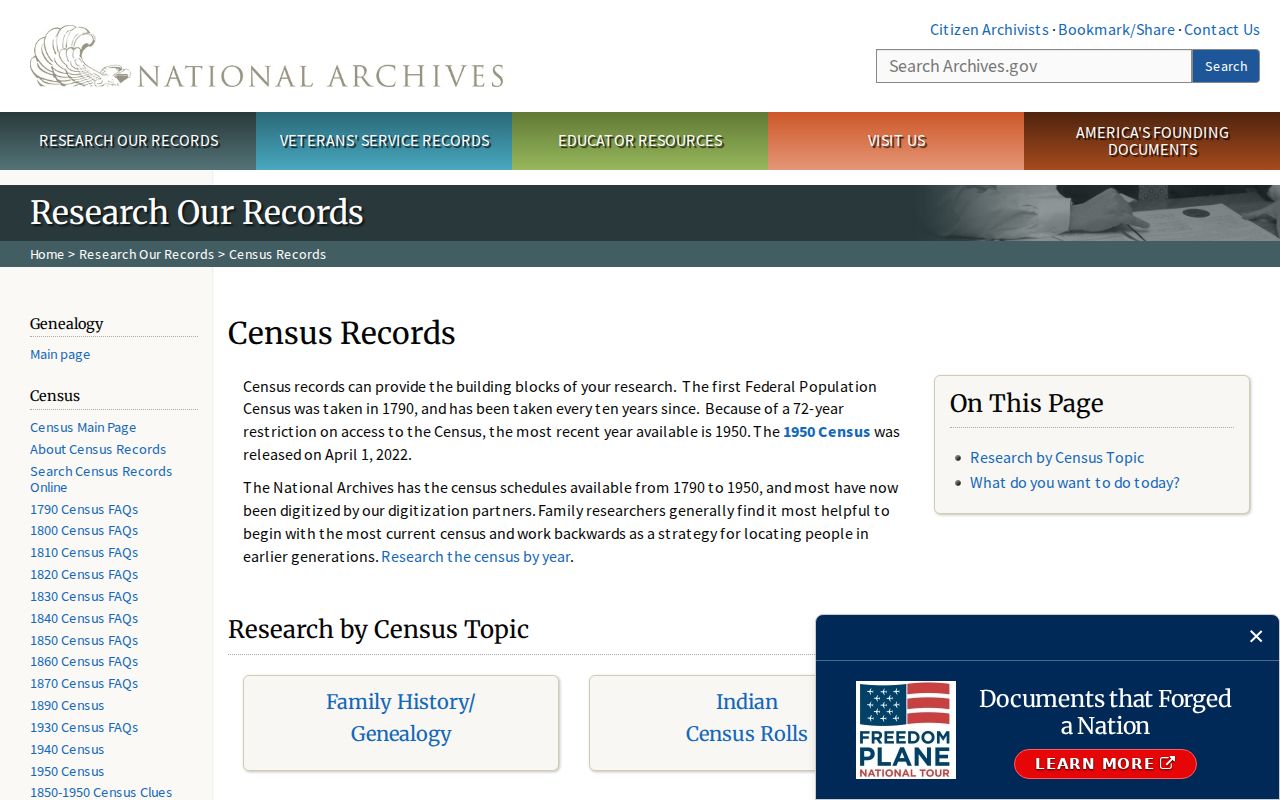
A census page is a dated household snapshot. It becomes useful in a house history when its address and date are compared with the other records.
Survive Alameda Street Renaming
Oakland grew through five annexations, and old street forms can disappear from a modern search. Quentin's Guide to the Streets of Northern Alameda County is the local bridge for changed names. The 2025 postal Place Name correction adds a second kind of change: a mailing line can change while ZIP, APN, taxes, services, and jurisdiction stay the same.
When an address is absent, try the original spelling, a number written as a word, the neighboring city line, and the APN or legal description. Compare the old address with a Sanborn map, assessor block book, Donogh card, or directory front matter. An address search that keeps the old and new forms is more reliable than a normalized one.
Historic maps and block books at the Oakland History Center can reconstruct a property before a modern parcel interface. The map is context; the recorded deed remains the title source.
Past Alameda Households and Endpoints
Previous residents can be followed until the sources stop. An obituary may name relatives, an address, occupation, funeral home, or burial place. Probate can connect a decedent to a petition or personal representative. A certificate can confirm an event if the requester qualifies. A cemetery record can locate a burial without proving the final residence.
Keep the conclusion modest. A deed identifies a title party. A directory identifies a listed householder. A census identifies a household at the enumeration date. A permit identifies an applicant or project contact. These records can converge on the same person, but their roles should not be collapsed.
House-history boundary. Research into Alameda County previous residents is appropriate for genealogy, estate work, and understanding a property. Do not use the trail to stalk, harass, track, or intimidate a living person. Verify important facts with the custodian.
Alameda Records Keep Moving Online
Alameda County's AB 1466 plan estimates about twenty million historic real-estate documents and eighty million images, with only about half electronic at the planning stage. OCR and restrictive-covenant review expand discoverability while preservation work keeps older microfilm and originals in view. A January 2025 board item described processing at about 8,000 images per day.
For a house history, this means an old deed or image may become easier to find without changing what the record proves. Recheck the live portal and retain the source date, instrument identifier, and limitation. New OCR can help locate a name, but a researcher should inspect the image when a legal description or identity matters.
An Alameda County previous-residents trail is strongest when every step keeps its custodian, date, identifier, access route, and uncertainty. That habit turns a set of clues into a defensible address history.